Stop the prompt before it leaves.
Prompts and responses routed through XAIGuard are scored, redacted or blocked inline — with a verdict you can explain to an auditor.
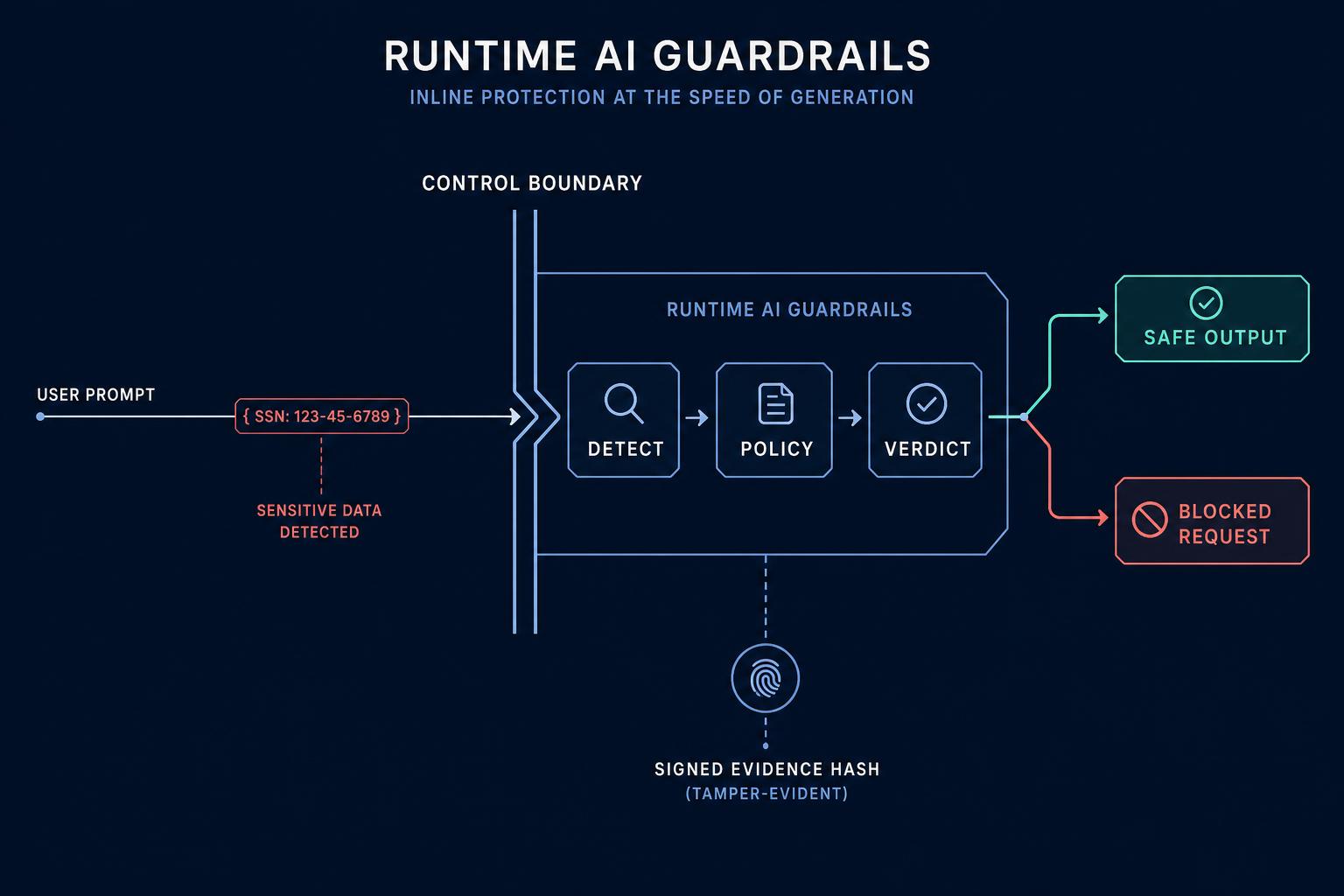
From prompt to verdict in four stages.
- 01
CLASSIFY
The prompt is scored across eight risk dimensions.
- 02
VALIDATE
Scores are checked for consistency and false-positive pressure.
- 03
POLICY
Your natural-language and preset policies are evaluated against the scores.
- 04
VERDICT
Allow, redact, or block. The decision and its reasoning are written to the audit chain.
What it does.
Eight-dimension risk scoring
Prompt injection, data exposure, tool over-privilege, control separation, monitoring gap, RAG security, context window and supply chain — scored per prompt, per response.
Inline DLP & redaction
Detect and redact sensitive entities inline so work continues without the data ever leaving the perimeter.
Natural-language policy authoring
Write policy in plain English. XAIGuard compiles it to enforceable scoring thresholds — no rules DSL to learn.
Preset policy packs
Opinionated starting packs for PII, source code, regulated data and prompt injection. Turn on, tune, done.
Bulk scanning
Scan historical prompt logs, datasets and prompt libraries to find what already leaked — before your auditor does.
REST scanning API
An OpenAI-compatible endpoint and standalone scoring API. Govern any SDK call by changing one base URL.
Streaming inspection, URL intelligence & semantic second pass
Streaming responses are inspected as they arrive, URLs in prompts and responses are checked for exfiltration destinations, and borderline cases get a semantic second pass rather than a hard pattern verdict.
Detection tuning
Tune thresholds and add scoped suppressions per detector so a pattern that is noise in your environment stops being noise, without disabling the detector everywhere.
Session traces
A multi-step agent run is reconstructed end to end — every prompt, tool call, retrieval and verdict in one timeline — so you can see how an agent reached a decision, not just that one call scored high.
One policy, one explainable verdict.
policy > "Never allow customer account numbers or unredacted contracts to reach an external model"
verdict: "BLOCK"
reason: "Customer account number detected in prompt"
matched_detectors: ["pii.account_number", "dlp.contract_text", "policy.nl-014"]
risk_scores: { pii: 0.98, exfiltration: 0.41, injection: 0.03 }
action: "block_and_alert"
latency_ms: 0.8
audit_hash: "ed25519:9f2c…a41e" — appended to tamper-evident chain
Map controls and evidence to leading AI governance frameworks — evidence, not assertion.
The eight risk dimensions.
- 01
Prompt injection
Override, jailbreak and instruction-hijack attempts.
- 02
Data exposure
Sensitive data heading into or out of the model.
- 03
Tool over-privilege
Unrestricted execution, privilege escalation, excessive agency.
- 04
Control separation
Instructions and untrusted content mixed in the same context.
- 05
Monitoring gap
Activity that would not be visible or recoverable after the fact.
- 06
RAG security
Retrieval pipeline injection, poisoning and leakage.
- 07
Context window
Oversized, stuffed or smuggled context.
- 08
Supply chain
Untrusted models, components and dependencies in the path.
PII, secrets, credentials, API keys and toxic content are caught inline by the DLP and guardrail layer on both the prompt and the response — they are enforcement detectors, not scoring dimensions.
Works together.
Deployment
PAC file, Browser Shield, API proxy or the self-hosted Connector — enforce from wherever your users already are.
ExploreAgent & MCP Governance
The same inline verdicts applied to autonomous agents and every MCP server they call.
ExploreCompliance & Evidence
Every allow, redact and block lands in a signed audit chain your auditor can verify.
Explore